A 60 SECOND GLANCING EYE ON BUSINESS, MARKETS & ECONOMY

Global Markets


Live World Indices are powered by Investing.com

Friday, 11 March 2016

EYE on the World - WHAT a Week! China, Hong Kong, Japan, Greece...

WHAT a Week!


Image result for breaking news button

 Chinese Exports #Meltdown by 25.4% YOY 


Image result for china economic disaster


China’s export slump deepened in February, highlighting the challenge for policy makers seeking to keep the economy humming at home while trade acts as a brake on growth. 
The week-long Chinese new year holidays fell in February this year, closing factories and curbing shipments. That saw exports tumble 25.4 percent in U.S. dollar terms from a year earlier, the biggest decline since May 2009. Imports extended a streak of declines to 16 months, slumping 13.8 percent, leaving a trade surplus of $32.6 billion. 
Image result for read article button

Bond Yields Sinking to Crazy New Lows

Government bond yields in Japan on Tuesday fell to record lows, and the ripple effect pushed down yields in the U.S., Germany and the U.K.
Strong auction demand for a 30-year Japanese government bond sent investors piling into bonds. The buying sent the yield on the benchmark U.S. 10-year note below 1.9% again and stalled the yield’s uptick momentum over the past month. As bond prices rise, yields fall. 


Hong Kong YOY Home Sales Meltdown, UNREAL 70%

The End of Good Times  


"Home prices in the city surged 370 percent from their 2003 trough through the September peak, spurred by low mortgage rates, tight supply of new units and buying from mainland Chinese. This year, BOCOM International Holdings Co. property analyst Alfred Lau has said prices could fall 30 percent amid a slowdown."


​ 
​
 Optimism Over Climate Change Progress Premature?
​ 


Comments

These are just a few of the possible facts out there that contradict Al Gore's assertions that we are somehow making progress. Have the icecaps stopped melting? Just saying we are reducing  carbon emissions 
​or made a bunch more solar cells  and so on,  ​
should not give anyone 
​real ​
comfort.  The state  and trends for all positive 
​climate ​
feedbacks loops needs to be identified  and monitored, 
otherwise we have no comprehensive idea as to what 
​the true ​
 
​trends and ​
state  the climate system is 
  
​- ​
along with the other integral biosphere systems that affect it.
​ ​

Let's be real and remember too that Al Gore is also a long-term politician who by the 
​ 
very nature of their roles often mislead, exaggerate and cloud the truth. Awareness of  these occupational hazards and habits alone speaks volumes , particularly as there is much  contrary evidence that the  comprehensive climate system is not improving.


​In
 sum, ​
it all sounds like more of the same ole political snake oil, so...​


We're just not buying  it!


Reality Check: Saudi Arabia is Going Broke!


Road to Poor House?


"All the Saudis have done is create an existential crisis for  themselves.

If the Saudis don’t stop flooding the market—and there are no signs they will—they won’t be

 shooting themselves in the foot… but in the head. Saudi Arabia will either collapse or surrender—and stop flooding the market.

Either way, oil will eventually go a lot higher." 

Image result for read article button


READ AHEAD OF THE WORLD
To subscribe or unsubscribe
​,​
 
​please ​
email 

-- 

Thursday, 10 March 2016

BIG OIL - Is There a Future?


World Will Need Big Oil


World will need big oil thumbnail
There are those who will tell you that this is a bad time to be running a big oil company. John Watson, chief executive of Chevron, is not among them. “Arguably, we’ve never been more advantaged than right now,” he says.
Of course, he acknowledges, times are tough for everyone in the oil industry because of the plunge in prices for crude and natural gas since the summer of 2014.

Compared to his competitors, though — whether the smaller independent oil producers in the US or the big national oil companies in emerging economies — Chevron is better placed to ride out the downturn and benefit from the upturn when it comes, he believes.
Critics of Chevron and the other big international oil companies suggest their business model is under threat, trapped in a pincer movement between the leaner and more agile shale operators, and curbs on demand for oil and gas imposed by government policies to reduce the threat of climate change.

In an interview with the Financial Times, Mr Watson, a 36-year Chevron veteran, rejects that critique. “I expect [Chevron] to be a viable and vibrant business for a long time,” he says. “There is still a good connection between economic growth, prosperity and consumption of energy. And we’re going to need all forms of energy.”

Chart: Oil majors' performance
With oil at $52 per barrel, which was the average price of Brent crude last year, Chevron does not look like a business with a great long-term future.
Its return on capital employed last year was just 2.5 per cent, and its cash outflows including capital spending and dividends exceeded its cash from operations by $22.5bn. Over the past five years, the company’s shares have significantly underperformed the S&P 500, reflecting a squeeze on profitability that began even before the slump in oil prices.
Mr Watson, however, argues that the factors that determine Chevron’s financial position will “come together pretty nicely for us over the next year or so”.

Between 2009 and 2012, Chevron embarked on an extraordinary investment binge, committing to a wave of very large projects. At its peak in 2014, its capital and exploration spending exceeded that of its rival ExxonMobil, even though Exxon’s market capitalisation was more than 80 per cent greater.

Chevron CEO John Watson

John S. Watson...John watson, Chief Executive Officer and Chairman of the Board of the Chevron Corporation in New York City
Now Chevron’s large projects are reaching completion. Gorgon, the $54bn liquefied natural gas development in Australia that is the largest of them all, is expected to ship its first cargo next week.

Others, including Wheatstone, another big LNG plant in Australia, and Big Foot, a deep water oil development in the Gulf of Mexico that was delayed by equipment failure, are coming on stream over the next couple of years.

As a result, Chevron’s oil and gas production is expected to grow by 13 per cent between 2015 and 2017, and continue increasing by about 1 per cent per year after that. Exxon’s production, by contrast, is expected to be roughly flat out to the end of the decade.

“As we finish those projects that are under construction, our capital spending will come down, and we get the added benefit that as those projects are coming on line, we will generate more cash,” says Mr Watson.

Due to cost-cutting, with 7,000 jobs going during 2015 and 2016, and the completion of those large projects, Chevron expects to be able to cover its capital spending and its dividend payments from its cash flows next year if oil is again at $52.

If oil is lower than that — Brent crude is this week trading at about $40 per barrel — then Mr Watson is prepared to keep borrowing to pay the dividend, because its shareholder base values the “predictability” of the payout.

Part of the price of that is Chevron has put the brakes on new projects. The company did not give the go-ahead to any large developments in 2015, and this year expects to approve just one: an investment to increase production at the huge Tengiz oilfield in Kazakhstan.
Chart: Capital spending being cut sharply
Instead, Chevron will focus on much smaller investments, such as additional wells to boost production at existing projects, and development of its own shale oil reserves in the Midland and Delaware basins of west Texas.


Chevron has an excellent position there: it calculates that it could drill 1,300 wells that would be financially attractive even with oil prices below $40, and it plans for production in west Texas to double by 2020, and possibly rise even faster.

Big projects, however, are the raison d’être of large oil companies, which are the only businesses with the financial strength and technical expertise to develop them.

Chart: Expected US shale productionIn shale, the big international oil companies were slow to see the opportunity, and have lagged behind their smaller rivals in efficiency. Chevron says it is catching up, but if the future of the oil industry lies in shale, then the big companies seem to have no decisive competitive edge.
However, Mr Watson argues that the hold-up in large projects is just a temporary hiatus. In the short run, the global oil market is oversupplied, and may remain so for a while, because of factors including the resilience of US shale and production from Iran coming on to world markets after the lifting of sanctions.

Oil majors’ business model under increasing pressure

BP, Chevron and Exxon walk a fine line between paying dividends and investing in operations
By the 2020s, he argues that big capital projects will be needed again. Shale can provide additional supply to meet rising demand for oil for a few years, but not forever.

“Shale is roughly 5 per cent of world supply,” he says. “As you think forward . . . Shale will be insufficient to meet that demand. We will need other classes of assets.”

While times may be hard for Chevron as it waits for that upturn, he adds, others have it even worse.

“We don’t have the stresses and strains that the independents have with stressed balance sheets,” says Mr Watson. “We don’t have the stresses that national oil companies have, where they’re trying to choose between reinvesting in the business at low prices [and] trying to feed their people and meet the social obligations that they have.

“At any kind of moderate prices, we’ll be growing production through the end of the decade, with good investments going forward. Others may not have that opportunity.”


 Image result for big oil business models

Financial Times

Source:

Wednesday, 9 March 2016

Falling Rig Counts, Means Higher #OIL Prices Later


Image result for international rigs

International Rig Count Still Falling


International Rig Count Still Falling thumbnail


The rig count data in all charts below is through February 2016.

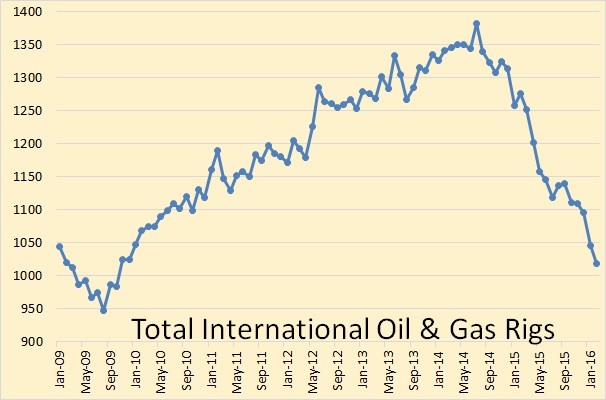
BH Total Intl.


The Baker Hughes International Rig Count does not include the US, Canada, any of the FSU countries or inland China. It does include offshore China. That rig count peaked in July 2014 at 1,382 rigs and in February stood at 1,018, down 364 rigs from the peak.


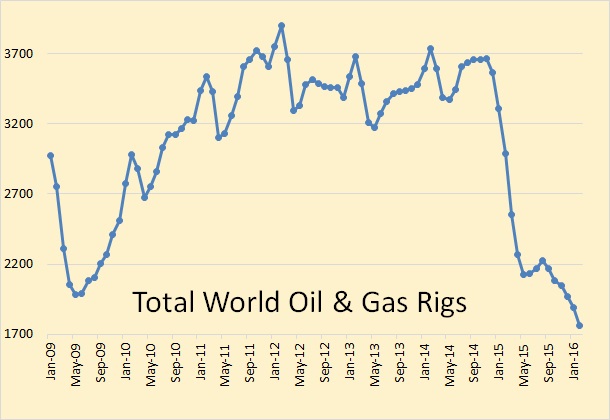
BH Total World


The Baker Hughes total world rig count does include US and Canada but not the FSU or inland China. That total oil & gas rig count stood at 1761 in February, down 52% since December of 2014.


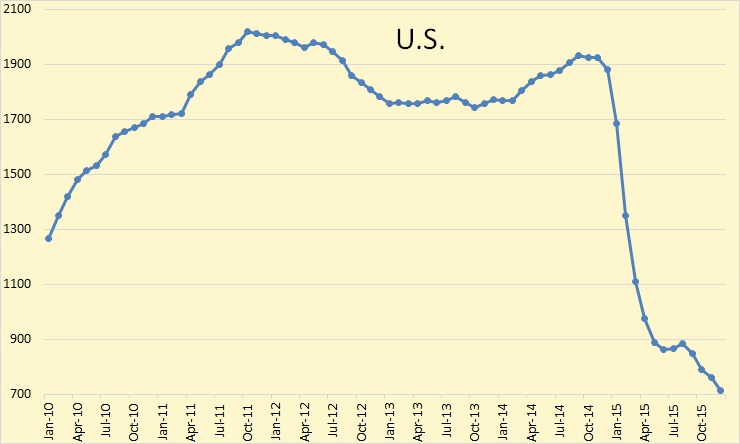
BH US Monthly


The US monthly total rig count stood at 532 in February, down 72% from November 2014.


BH Canada


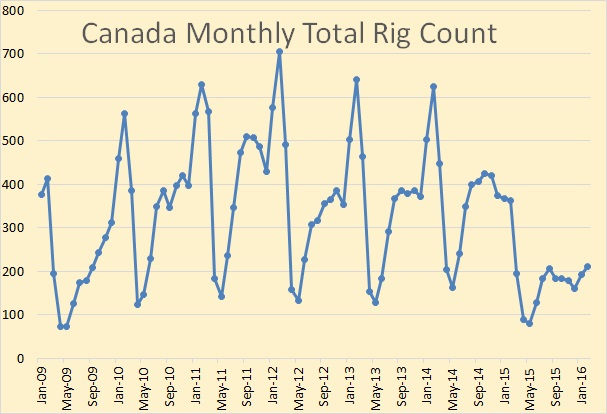
The Canadian total rig count usually peaks in February. It did not in 2015 but stood at 211 this February which will likely be the peak for 2016. That count is down from 626 rigs in February 2014, down over 66%. That was the last pre-price crash February peak.

BH Total Intl Oil Rigs


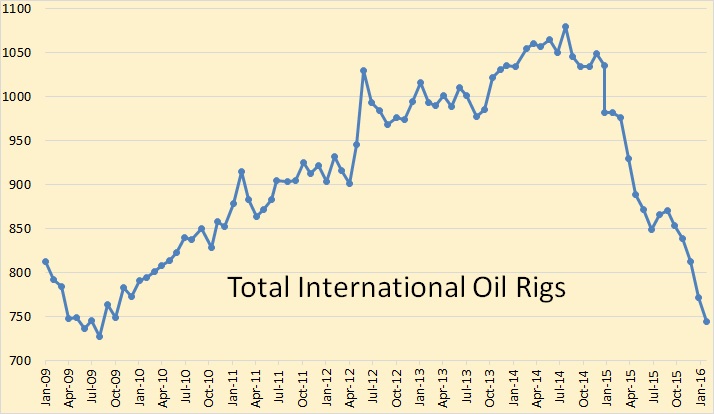
Looking at oil rigs only, total international oil rigs dropped another 28 rigs in February to 744 rigs. That is down 336 rigs or 32% since the July 2014 peak.


BH Saudi et. al.


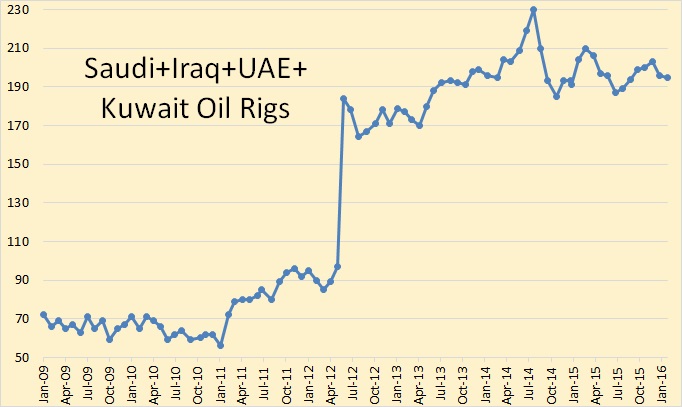
Four nations where the rig count has not collapsed is Saudi Arabia, the UAE and Kuwait and Iraq. The huge jump you see in June 2012 was due to Iraq going from 0 rigs to 78 rigs.


BH Intl Rigs Less


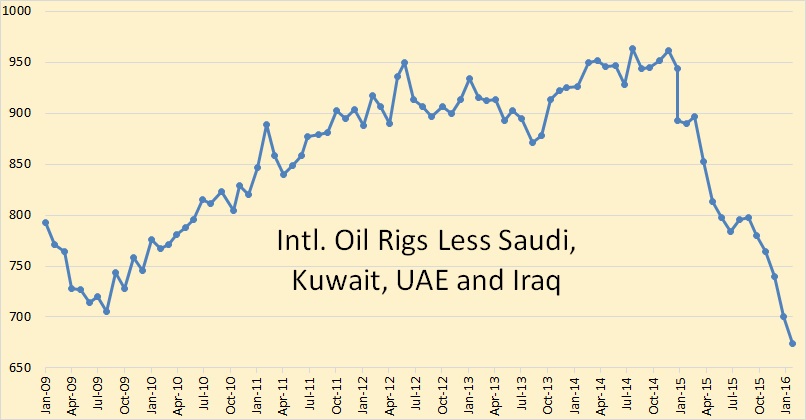
International oil rigs, less Saudi, UAE, Kuwait and Iraq peaked in July 2014 and have declined 30% since that date.
But what has all this done for production… so far.


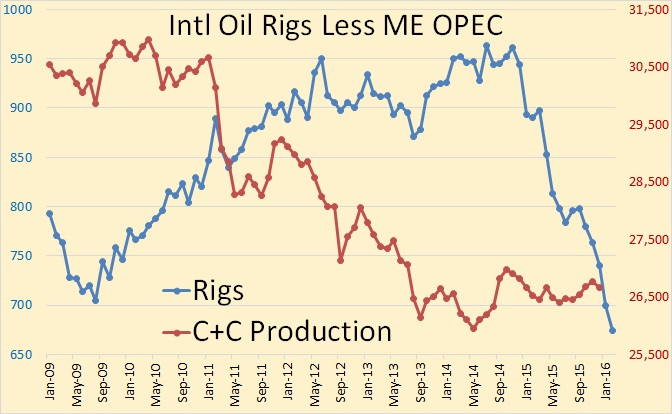
BH Intl Rigs Less ME OPEC


The production data, right axis, in the above chart is only through December while the rig data, left axis, is through February. Production fell all through the rise in rig count then began to plateau in mid 2013. The rising rig count did not increase production but the falling rig count will almost certainly cause it to decline… after a delay of one to two years of course.

Again, the above oil rig only charts does not include the US, Canada, any FSU nation or China.


Source:

Blog Archive

Earth In Trouble